Painting a Victorian Terrace in South London
What's different about these houses, and how to decorate them properly.
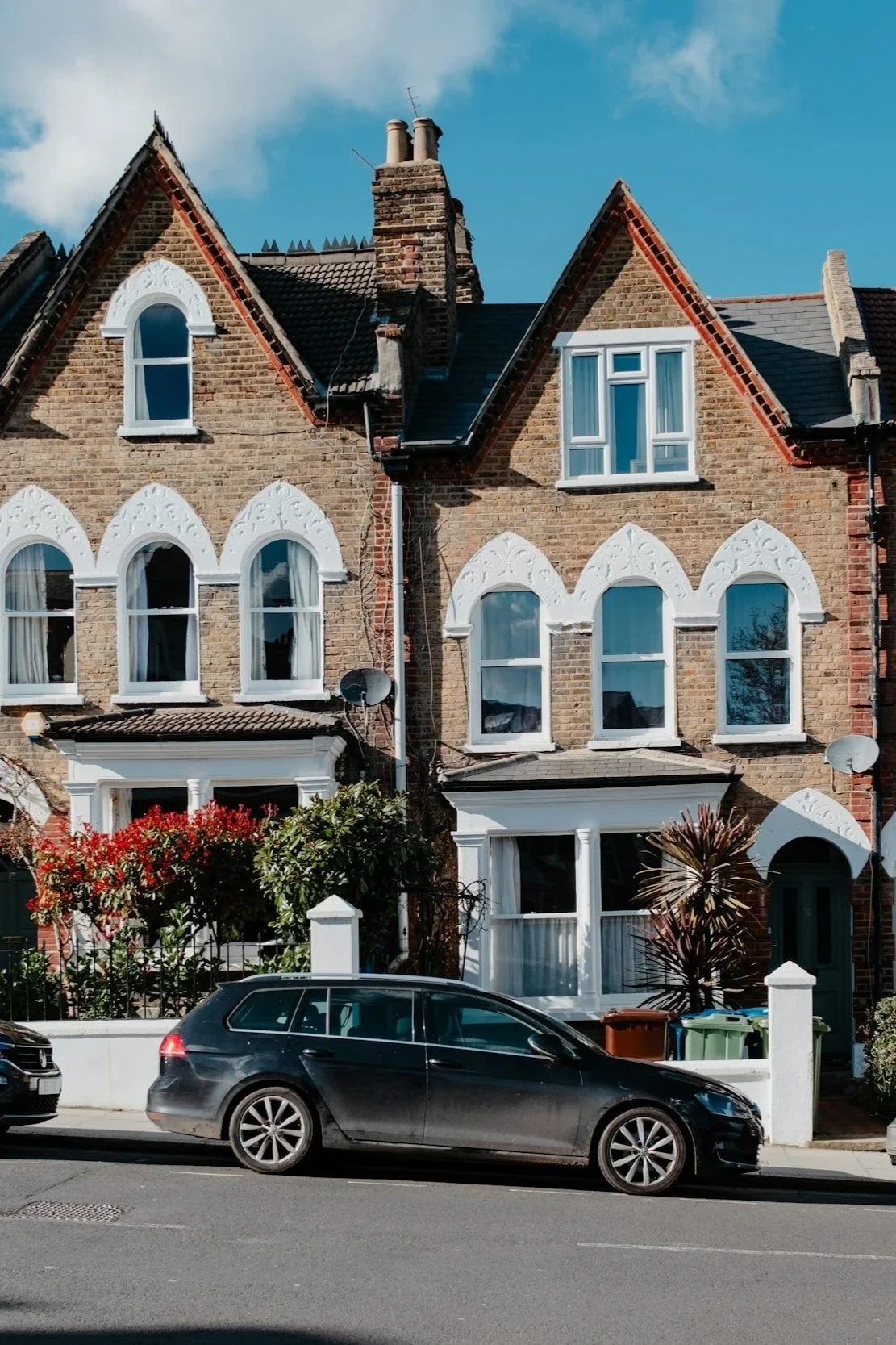
Most of the houses I paint in Dulwich, Herne Hill and Peckham are Victorian terraces built between 1870 and 1905. If you live in one, you know the rhythm already — high ceilings, bay windows at the front, picture rail at 2.4m, a fireplace in every main room (probably blocked up), a kitchen extension that's been rebuilt at some point, and walls that are anything but flat.
This post is about what to expect if you're planning to decorate one properly.
What a Victorian terrace is made of
Three main construction realities:
Lath and plaster
Internal walls and ceilings in any original part of the house. Thin wooden laths nailed across the studs, with coarse lime plaster pushed into and around them, then finished with a smoother topcoat.
What this means for decorating:
- Flexible, takes movement without cracking
- Breathable, lets moisture pass through
- Can't take modern plasterboard treatments without ripping it out
- Can develop hairline cracks that keep coming back
- Sometimes has hollow spots where the plaster has come away from the laths
Lime plaster on brick
Where the walls aren't lath-and-plaster, they're usually solid brick with a lime render and lime plaster finish.
What this means:
- Modern vinyl emulsion doesn't bond well in the long term — will crack off in 5-10 years
- Needs breathable paint (F&B Dead Flat, Earthborn Claypaint, Little Greene Intelligent Matt)
- Shows moisture history — old damp patches come back as salt bleed-through
Gypsum skim on top
In the parts of the house that have been "done" in the last 20 years, there's usually a modern gypsum skim over the original plaster. Acts like any new-build wall — takes normal emulsion, sands flat.
How to tell which wall is which
Quick test: tap the wall with your knuckle. A hollow, thuddy sound is likely lath-and-plaster. A solid, sharp knock is likely brick. A slightly hollow, drummy sound in a newly-done house is likely plasterboard over the original.
If in doubt, I'll check when I'm there.
Why prep on a Victorian takes longer
Four specific reasons:
1. More surface area per room. A Victorian reception room has 3m ceilings, big sash windows, deep skirting, often a picture rail and usually cornice. All of it needs prepping and painting.
2. Historic damage. Every Victorian house has a legacy of previous repairs, bad decorators, and hairline cracks that keep coming back. These need filling, flexing, and sometimes re-filling with proper two-part filler.
3. Original detail. Cornice and ceiling roses have often been over-painted four or five times. Painting them without building up more gunge takes time.
4. Settling. The house has been moving for 130 years. Every mitred corner on the woodwork has likely opened up. Every joint between wall and ceiling probably has a crack running along it somewhere.
My process on a typical Victorian room
Day 1: Mask, sheet, protect. Fill every hairline crack, every nail pop, every historic hole. Caulk every joint. Leave to dry.
Day 2: Festool PLANEX on all walls and ceiling. Take down any nibs, flatten filler. Check cornice for obvious paint build-up areas but don't try to strip.
Day 3: Stain block any water marks, prime any bare patches, mist coat any fresh plaster. Second round of filling where primer has revealed issues.
Day 4: First coat emulsion on walls and ceiling. First coat eggshell on woodwork.
Day 5: Second coat everything. Cut in cornice detail carefully.
Day 6: Final touch-ups, walk-through, clean-down.
A single large Victorian reception room with original cornice and detail takes 4-6 days.
Paints that suit Victorian homes
For lime-plastered walls:
- Farrow & Ball Dead Flat — fully breathable, stunning depth of matt colour, slightly less durable than modern matts
- Earthborn Claypaint — natural clay-based, beautiful on old walls, eco-friendly
- Little Greene Intelligent Matt — breathable, scrubbable, my default for period walls where clients have kids
For gypsum-skimmed walls (much of the updated stock):
- Little Greene Intelligent Matt
- Dulux Trade Vinyl Matt (good-value workhorse)
- Farrow & Ball Modern Emulsion (durable F&B)
For Victorian woodwork:
- Mylands oil-based eggshell — traditional, hand-painted look, hardens beautifully, slightly yellows
- Tikkurila Helmi 10 water-based — modern, no yellowing, very durable
Colour in a Victorian terrace
Victorian houses have great light on the ground floor and trickier dark light upstairs. Colour choices that work well:
- Big Victorian living rooms: deep saturated colours work brilliantly — F&B Hague Blue, Little Greene Invisible Green, Mylands Stone Castle Grey. The period detail and cornice take deep colour beautifully.
- Upper-floor bedrooms (often darker): warm whites that don't look cold. F&B Slipper Satin, Little Greene Slaked Lime, Strong White.
- Dark hallways: embrace the dark. F&B Railings, Little Greene Basalt. Don't try to paint a dark hallway brilliant white — it still reads grey.
- Ceilings: match the white warmth to the walls. Don't default to pure brilliant white unless the walls are very cool — it looks clinical.
Common mistakes
- Skimming over lath and plaster. Seems like an upgrade, actually trades a flexible wall for a rigid one that will crack.
- Vinyl emulsion on lime plaster. Peels off in 5-10 years.
- Trying to strip cornice paint yourself. Specialist restoration job; damaging the detail is easy.
- Filling cracks without caulk. The crack comes back.
- Pure white ceilings with warm walls. Looks mismatched.
Frequently Asked Questions
About Painting And Decorating A Victorian Terrace House
-
Not fully, without skimming. A little bit of filler helps, but if the walls are significantly uneven my builder brother can skim them before I paint. Adds time and cost but transforms the finish.
-
Yes, carefully. I won't try to strip existing paint layers — that's a restoration job. I can paint it without making it worse while keeping the detail visible.
-
Fix first, always. Damp isn't fixed by paint. Find the source (usually external), repair it, let the wall dry out, then repaint with a breathable paint.
-
Breathable paint lets moisture pass through the wall, preventing damp from being trapped. Normal emulsion traps moisture. On modern plasterboard walls it doesn't matter; on old lime plaster it matters a lot.
-
No. A three-bed Victorian done properly takes 2-3 weeks. Anyone telling you a week is cutting corners somewhere.
-
Yes, always. Once it's gone it's gone, and modern replacements never quite match the character. If yours is caked in paint, I can paint it carefully without making it worse.
How a quote works
1. Send me photos.
WhatsApp (07933 509672) or fill in the form opposite. A shot of each room, anything tricky (mould, peeling, damp, wallpaper, water stains), and the rough size if you know it.
2. I'll send a clear, fixed quote.
Usually within 24 hours. Written down, broken out by room, no surprises at the end.
3. Optional, I'll pop round.
If it's a bigger job or there's anything unusual, I'll come and see it in person before we commit. No charge, no sales pitch.
4. Book in and paint.
Agreed start date, agreed finish date. Tidy site every evening, final walk-through at the end.