Why Dustless Sanding Matters
What proper dust extraction buys you on a decorating job — for your house, your lungs, and the finish itself.
I've used a Festool PLANEX on every job for the last three years. Before that I used a regular random-orbit sander and lived with the dust. The jump to a proper dust-extracted setup is the single biggest upgrade I've made to how I work. This post explains why.
What a Festool PLANEX is
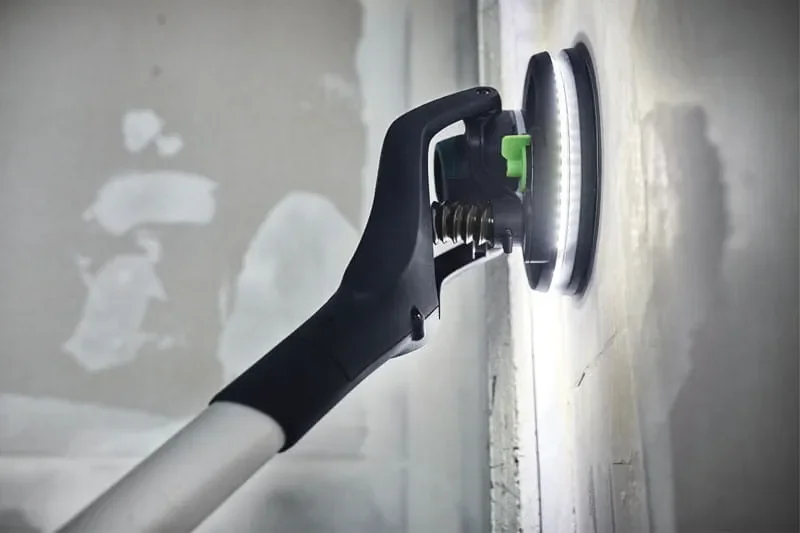
A long-reach random-orbit sander made by Festool in Germany. 12-inch head, articulates round edges, plugs into an dustless vacuum extractor that catches dust at source. It takes about 98% of dust out of the air before it gets into the room.
Key features:
- Long reach. Sand a 3m Victorian ceiling without a ladder.
- Articulating head. Follows the contour of a wall instead of gouging it.
- Variable speed. 4,000 to 10,000 rpm for different tasks.
- Brushless motor. Lasts forever.
- M-class extraction. Catches fine dust that would otherwise become airborne.
What this means for your house
Three concrete things:
You can live in the house while I'm working. Most of my clients are working from home while I'm there. Without dust extraction this is genuinely unpleasant — fine dust gets everywhere, coats every surface, takes weeks to clear out. With dustless sanding, they barely notice.
No week-long cleanup after I've left. Traditional decorating leaves a fine white dust on every surface for days afterwards. It gets into clothes, food, kids' toys, electronics. With dust extraction there's almost none.
A better finish. Sounds counter-intuitive, but here's why. With proper extraction I'm willing to really sand properly — take cracks back to the plaster, flatten filler properly, smooth the woodwork between coats. Without extraction, most decorators (me included, once upon a time) rush the sanding or skip it altogether, because the alternative is sharing your house with a week of airborne dust.
Dust extraction isn't just about cleanliness. It's about being able to do the job properly.
What this means for everyone’s lungs
Construction dust is a known carcinogen. Long-term exposure causes silicosis and COPD. The HSE has been tightening rules on wood dust and silica for years. A sole-trader decorator who doesn't use proper extraction has a significant occupational risk.
I used to wear FFP3 masks on sanding-heavy jobs. I still do for certain tasks, but the day-to-day exposure is massively lower with proper extraction.
This matters to clients too. If your decorator isn't protecting themselves, they're probably not protecting your air either.
What I use it for
Walls. The main use. Sanding back filler after it's dried, keying previously-painted surfaces for adhesion, smoothing any rough patches before primer. I can do a whole room of walls in 45 minutes with the LEROS, compared to 2 hours of manual sanding.
Ceilings. The LEROS' long reach was made for ceilings. No podium, no ladder-hopping. A smooth sand of a whole 4m x 4m ceiling in 10-15 minutes.
Woodwork. I switch to the Festool PLANEX (the 150mm round sander) for woodwork. Same dust-free system, better for smaller surfaces.
Between coats. A quick pass with 240-grit between primer and topcoat, or between topcoats. Makes a massive difference to the finish.
How this compares to other methods
Wet sanding. Some decorators prefer wet sanding — sand with water, creates a slurry, no dust. Works well on small areas but is slow and messy on a full-room job.
Pole sanding. Hand-held pole with a sanding pad on the end. No dust extraction, all manual effort. Fine for a single quick job, unusable for a whole house.
Random-orbit sander without extraction. Fast but kicks up a lot of dust. Most tradespeople who do this wear a mask but the dust still coats the house.
Festool PLANEX with M-class extraction. Fast, low-dust, produces a better finish because proper sanding actually happens.
What to ask your decorator (irrespective of who you use)
"Do you use dust extraction when sanding?" A proper answer mentions an M-class vacuum and a sander that plugs into it.
"Will I be able to use the house while you work?" The honest answer depends on the sanding setup. With proper extraction: yes. Without: mostly no.
"What brand of sander do you use?" Festool, Mikra and Bosch all make good dust-extracted systems. A quality answer names a brand.
Let's talk about your job
Send me some photos and I'll come back with a fixed quote. Dust extraction is included as standard on every job I do.
Frequently Asked Questions
About Dustless Sanding For Painting and Decorating
-
Not zero dust, but about 98% captured at source. Most clients genuinely don't notice.
-
Standard dust sheets are fine. You won't need to wrap everything in plastic or move things out.
-
Yes, most of my clients do. Earbuds recommended for the sander noise, but the dust isn't a problem.
-
Better than traditional sanding. Less airborne dust, no water waste, re-usable abrasives.
-
A European standard for vacuum filtration. M-class filters catch 99.9% of particles down to fine dust. L-class is for larger debris only and won't catch what a sander produces.
-
Mainly, yes. Exterior sanding is less of a dust concern because you're outside, though I still use extraction for cleanliness and for my own lungs.
How a quote works
1. Send me photos.
WhatsApp (07933 509672) or fill in the form opposite. A shot of each room, anything tricky (mould, peeling, damp, wallpaper, water stains), and the rough size if you know it.
2. I'll send a clear, fixed quote.
Usually within 24 hours. Written down, broken out by room, no surprises at the end.
3. Optional, I'll pop round.
If it's a bigger job or there's anything unusual, I'll come and see it in person before we commit. No charge, no sales pitch.
4. Book in and paint.
Agreed start date, agreed finish date. Tidy site every evening, final walk-through at the end.