Exterior Painting in East Dulwich & South East London
Masonry, render, timber and front doors, done at the right time of year with the right paint for the job.
There's a narrow window every year where it makes sense to paint the outside of a house in South London. Roughly April through to September, with a decent run of dry days and no cold nights. Outside that window the paint doesn't cure properly and the finish won't last.
When I quote an exterior job I plan it round the weather. If we need to wait a couple of weeks for a dry run, we wait. Better a job that lasts ten years than one that's peeling by March.
What I paint on the outside
- Painted brick and masonry (front and rear elevations)
- Render, stucco and pebbledash
- Timber cladding and weatherboard
- Sash window frames, cills, glazing bars
- Front doors and porch woodwork
- Soffits, fascias and bargeboards (up to two storeys from tower)
- Painted metal railings, gates and balconies
My exterior process
1. Weather check. Before start date I'll look at the 10-day forecast and confirm we've got a sensible run of dry, warm days. If not, we shift it.
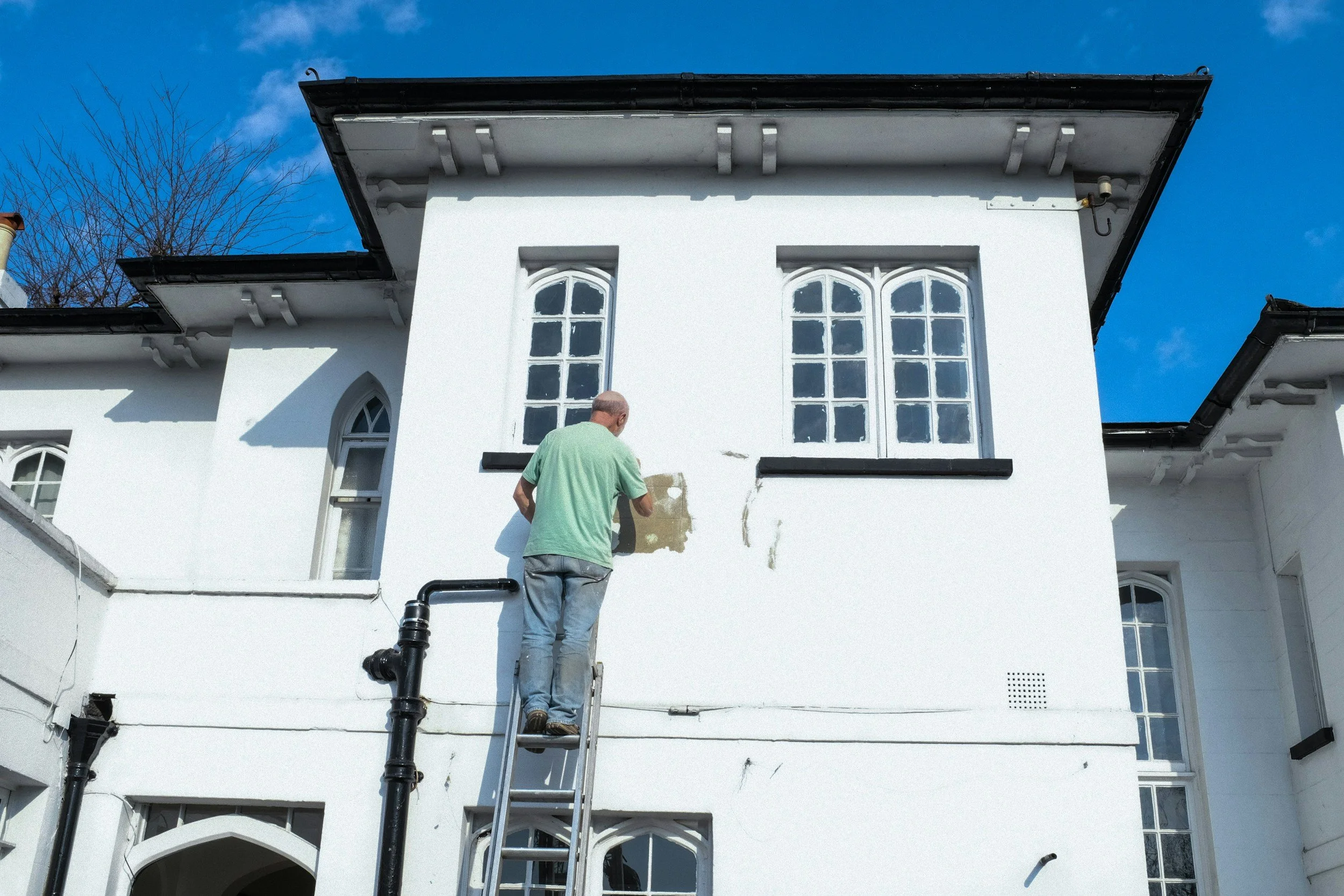
2. Clean down. Jet wash where it's needed, manual scraping where it's not, fungicidal wash on anything showing algae or mould, stabilising solution on chalky masonry. You can't paint over dirt.
3. Repair. Re-pointing where mortar has blown. Rotten timber cut out and spliced where it's salvageable, replaced where it's not. Two-part filler on timber damage, decorator's caulk on flexible joints.
4. Prime. The right primer for each substrate. Zinsser Cover Stain or BIN on bare timber and knots. Sandtex Flexigloss primer on galvanised metal. Stabilising sealer on powdery masonry.
5. Paint, in the right weather. Two coats as standard, three on dark colours or south-facing walls that take heavy sun. I work round the sun so I'm not laying paint onto a wall that's too hot to cure evenly.
6. Hand-finish the detail. Sash frames, cills and trim get hand-painted with proper brushes, not sprayed. Spray lines look wrong on a Victorian house.
Paints I use
- Dulux Weathershield Smooth Masonry — reliable workhorse for painted brick and render. 15 years on a properly-prepped wall.
- Sandtex High Cover — a bit more flexible than Weathershield, great for textured render.
- Johnstone's Stormshield — when the wall has a bit of damp history and needs extra resistance.
- Zinsser Allcoat — my secret weapon. Water-based, sticks to almost anything, perfect for metal railings, plastic fascias and mixed-substrate jobs.
- Mylands Marble Matt or Eggshell — for front doors where you want a rich, hand-painted finish.
- Tikkurila Helmi — for exterior woodwork that needs serious durability.
Front doors — a Dulwich speciality
If you're in Dulwich, your front door probably came with the house. Original panelled pine, sometimes with stained glass, often with fifty years of repaints gone streaky and five coats of paint filling the detail.
I love a front door job. Taken off the hinges where possible, laid flat, stripped back where it needs it, filled, sanded, grain-filled if it's open-grained, two coats of primer, two coats of eggshell or gloss in a colour you've actually chosen. New draft strip, new letterbox brush, back on the hinges. A proper front door re-do is £400 to £650 and changes how the whole house feels.
What it costs
Indicative ranges. Fixed quote once I've seen photos or done a site visit.
- Front door (strip, fill, paint, re-hang) — £400 to £650
- Masonry front elevation (Victorian terrace) — £1,800 to £3,200
- All exterior woodwork (sashes, fascias, bargeboards) — £1,500 to £3,500
- Full house exterior (terrace, masonry + woodwork) — £4,500 to £9,500
- Detached house full exterior — £7,500 to £15,000+
Frequently Asked Questions
About Exterior House Painting
-
Mid-April to late September is the working window in London. I'll book exterior jobs for these months and plan round the weather. I won't paint exterior work in November or February, no matter how mild it looks.
-
For a standard two-storey terrace I usually work from a tower scaffold, hired in as part of the job. For three-storey or bigger properties I'll bring in a proper scaffolder and factor that into the quote.
-
Yes, either from a tin if they've still got some, or by taking a sample and getting it matched at the merchant. Most of the London off-whites and creams I know by heart.
-
Yes. They need a specific primer (not just any undercoat) and the right paint on top. Zinsser Allcoat or Hammerite Direct to Galvanised depending on the look you want.
-
Properly prepped and painted, masonry should give you 10 to 15 years on a sheltered wall, 8 to 10 on a south-facing elevation. Woodwork is shorter — 5 to 8 years before it needs another coat.
-
Yes. Most of Dulwich and Camberwell is covered by conservation area guidance or the Dulwich Estate Scheme of Management. I'll check the paperwork with you before any exterior colour change.
How a quote works
1. Send me photos.
WhatsApp (07933 509672) or fill in the form opposite. A shot of each room, anything tricky (mould, peeling, damp, wallpaper, water stains), and the rough size if you know it.
2. I'll send a clear, fixed quote.
Usually within 24 hours. Written down, broken out by room, no surprises at the end.
3. Optional, I'll pop round.
If it's a bigger job or there's anything unusual, I'll come and see it in person before we commit. No charge, no sales pitch.
4. Book in and paint.
Agreed start date, agreed finish date. Tidy site every evening, final walk-through at the end.